
A Trip to the Dentist Turned Into Running Advice
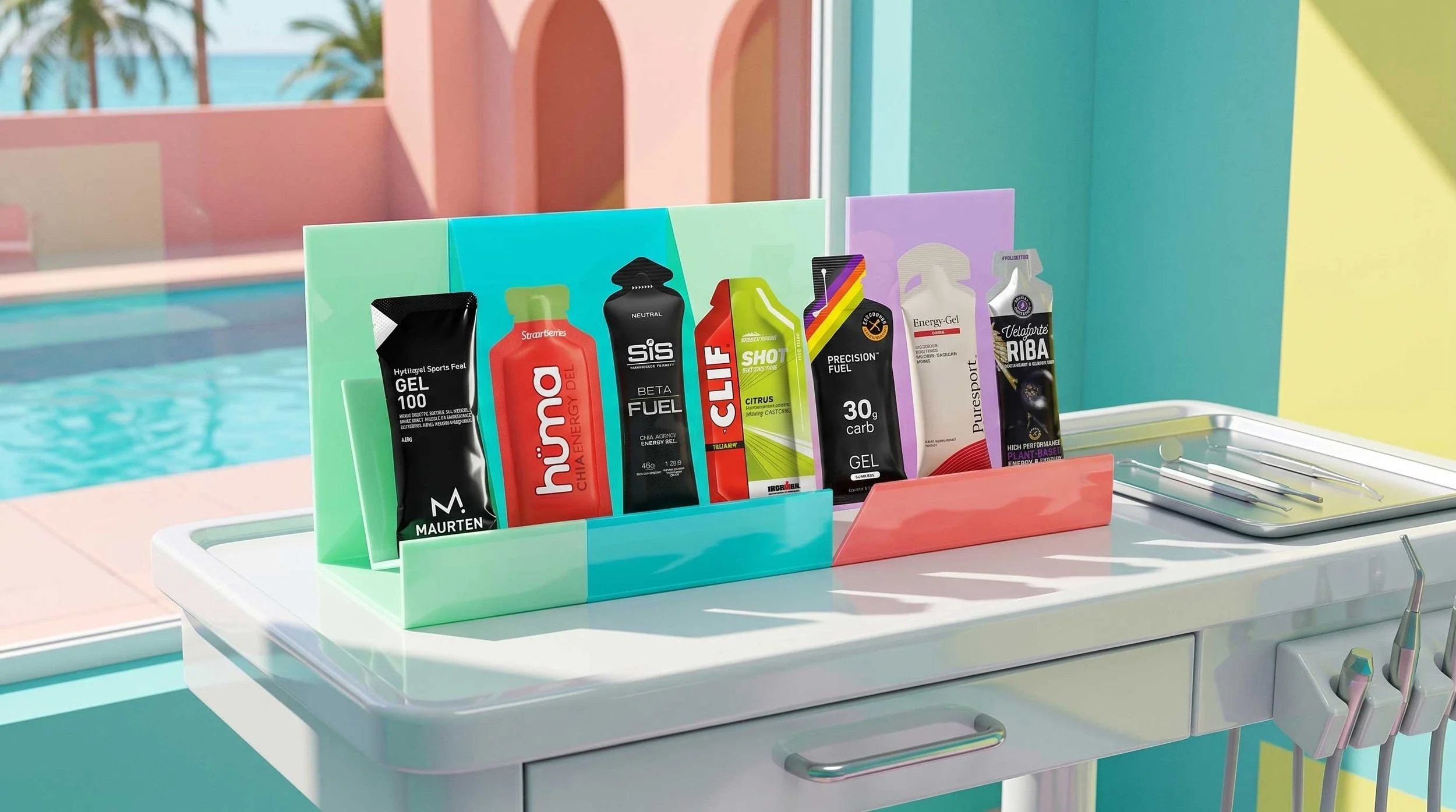
How one new hole in a tooth led to an unexpected conversation about gels, fuelling, and whether endurance sport is quietly trying to ruin our mouths
Sit down. Open wide. Pretend you floss more than you do. Nod seriously at everything being said. Then came the words nobody really wants to hear.
“You’ve got a new hole in a tooth.”
Brilliant. Not exactly the kind of personal best anyone is chasing.
Then, just as I was preparing for the usual chat about brushing better, eating less rubbish, and generally trying to behave like a responsible adult, the dentist asked a question I was not expecting.
“Do you take gels when you run?”
Maybe. Why?
And just like that, what should have been a routine dental appointment somehow turned into running advice.
Which, to be fair, feels very on brand for Idiots Go Running.
The surprising link between gels and your teeth
For most runners, gels are just part of the deal.
You head out for a long run, a marathon session, or a race, and at some point it becomes clear that water and positive thinking are not going to cut it. So out comes the gel. Rip. Squeeze. Swallow. Try not to wear half of it. Job done.
Except, according to the dentist, maybe not quite. Because while gels are brilliant at helping tired legs keep moving, they can also be less brilliant for your teeth. And once you think about it, it makes a lot of sense.
They are usually sweet, often acidic, and almost always sticky. Which, as it turns out, is not the dream combination for dental health. So yes, the thing helping you survive mile 18 may also be quietly plotting against your enamel.
Why gels can cause trouble
The problem is not just sugar on its own. It is the full endurance-sport cocktail of sugar, acid, stickiness, frequency, and dry mouth.
When you run for a long time, especially hard, your mouth gets dry. Saliva normally helps protect your teeth by washing things away and neutralising acid, but during a session that defence system is not exactly firing on all cylinders.
Then along comes a gel. Fast carbs. Sweet taste. Often fruit-based flavours. Sometimes acidic ingredients. And if you do not wash it down properly, it can sit around your teeth longer than it should.
That can lead to two main problems.
One is tooth decay, where sugar feeds bacteria in the mouth and those bacteria produce acids that attack the tooth.
The other is enamel erosion, where acid itself starts wearing away the surface of the tooth.
So if you are regularly taking gels on long runs, especially without much water, you are not just fuelling your race. You may also be sponsoring a small but very committed attack on your molars.
Not all gels are equally bad
This is the interesting bit. The dentist was not saying, “Never take gels again.” That would be nonsense. If you are doing long efforts, fuelling matters. Under-fuelling your run to save your teeth is not exactly a masterstroke either.
In general, the better options for teeth seem to be the ones that are:
more neutral in flavour
less acidic
less sticky in the mouth
easier to get down quickly
used in proper doses rather than constantly sipped
That means those really fruity, sharp, citrusy gels may be the ones to be a bit more careful with. If it tastes like it could strip paint off a garden fence, your teeth might not be thrilled about it either. Neutral-style gels, on the other hand, may be the better bet.
So what gels seem better?
From a practical runner’s point of view, the “least bad” options tend to be the more neutral and simpler formulas.
Maurten Gel 100 often gets mentioned as a good option because it is a stripped-back formula and does not lean into big acidic fruit flavours.
Precision Fuel & Hydration PF 30 Gel also looks like a sensible choice because it is mild and designed to be less sticky in the mouth.
SiS Beta Fuel Neutral is another strong option, especially if higher carbs per gel means you need fewer of them across a run.
That is worth thinking about. Sometimes the issue is not just what gel you take, but how many times your teeth get hit during a session. So yes, in elite sports science terms, fewer sticky mouth attacks per hour is probably a good thing.
The habits that matter most
The good news is that this is not one of those articles that ends by telling you to stop fuelling and start carrying almonds in your pocket. There are some simple ways to reduce the damage without wrecking your performance.
The biggest one is this: always take gels with water. Not “I’ll maybe have a sip later.” Properly with water. That helps clear the sugar and acid away from your teeth and gets rid of the sticky residue.
Second, avoid grazing. Taking half a gel, letting it sit around your mouth, then going back to it later is probably one of the worst things you can do from a dental point of view. Better to take it properly, get it down, wash it through, and move on.
Basically, treat it like race fuel, not a fine dining experience. After the run, rinse your mouth with water. Then wait a bit before brushing. Brushing immediately after acidic exposure can make things worse because enamel can be more vulnerable straight after.
Fluoride toothpaste helps. A fluoride mouthwash used at a different time of day can help too. Sugar-free gum after a run may also be useful because it gets saliva flowing again, and that is one of your mouth’s natural protective tools.
So the simple dental survival plan for runners is this:
Take the gel.
Drink the water.
Rinse after.
Wait before brushing.
Try not to turn your mouth into an aid station.
The real takeaway
What made the dentist conversation interesting was that it was not really a lecture. It was more of a lightbulb moment. Because most runners think about gels in terms of stomach, legs, pace, and energy. We think about whether they work, whether they taste grim, whether they upset the gut, and whether they can get us to the finish line without seeing God at mile 22.
We do not always think about what they are doing to our teeth. But maybe we should. That does not mean gels are the enemy. They are useful. They work. They are part of endurance sport.
It just means that, like most things in running, there is usually a catch.
The shoes that cost too much but somehow feel essential.
The long run that is good for your fitness but bad for your social life.
The recovery shake that tastes like wallpaper paste but promises miracles.
And now, apparently, the gel that saves your marathon while quietly irritating your dentist.
So yes, a routine trip to the dentist turned into running advice.